
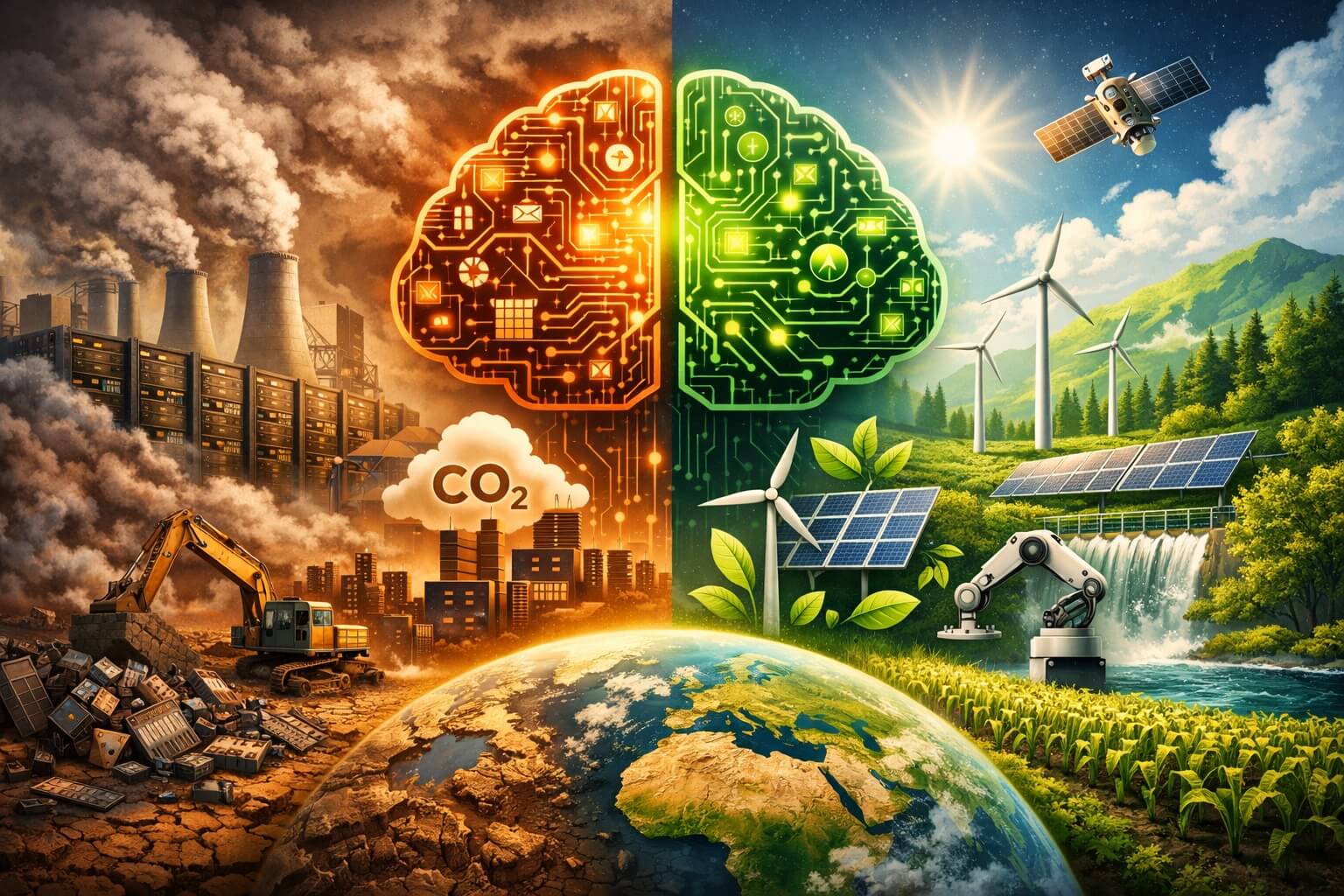
Artificial Intelligence is transforming how we work, communicate, and solve problems. From chatbots and search engines to image generation and automation, AI is becoming part of everyday life. But with this rapid growth comes a serious and valid question:
Is using AI bad for the environment?
The answer is not a simple yes or no. AI has real environmental costs, but it also offers unprecedented tools to fight climate change and resource waste. Understanding the full picture requires looking at energy use, emissions, water consumption, hardware production, and—most importantly—how AI is applied.
This article breaks down the environmental impact of AI in detail, separating myths from measurable facts.
Understanding AI’s Environmental Footprint
1. Energy Use: Training vs. Everyday Usage
AI systems consume electricity at two very different stages:
🔹 Model Training (High Impact)
Training large AI models requires:
- Thousands of GPUs or specialized accelerators
- Continuous operation for days or weeks
- Massive parallel computation
This stage accounts for the majority of AI’s energy consumption.
However:
- Training happens once or infrequently
- The same trained model can be used by millions of people
🔹 Inference (Daily Usage – Lower Impact)
Everyday AI use—chatting, summarizing text, translating, searching—uses significantly less energy.
For comparison:
- Generating text typically consumes less energy than streaming a short video
- A single AI query is far less energy-intensive than many assume
👉 Key takeaway: Most environmental impact comes from building the model, not from normal user interaction.
2. Carbon Emissions: Power Source Matters More Than AI Itself
AI does not inherently produce carbon emissions. Emissions depend on how electricity is generated.
- Coal-powered data centers → high emissions
- Renewable-powered data centers → drastically lower footprint
Major AI infrastructure providers are actively shifting toward:
- Solar and wind energy
- Carbon offsets
- Long-term renewable energy contracts
Some large data centers already operate at or near carbon neutrality.
👉 AI’s carbon footprint is primarily an energy policy issue, not a technology flaw.
3. Water Consumption: A Hidden but Important Cost
AI data centers generate heat, and cooling that heat often requires water.
Why water is used:
- Evaporative cooling systems
- Climate control for sensitive hardware
Environmental concerns:
- Water stress in dry regions
- Competing needs with local communities
Industry responses:
- Closed-loop cooling systems
- Air-based cooling
- Data center placement in cooler climates
- Water recycling technologies
Water use is real—but increasingly measured, regulated, and optimized.
4. Hardware Manufacturing and Resource Extraction
AI depends on:
- GPUs
- High-performance memory
- Specialized chips
These require:
- Mining of rare earth metals
- Energy-intensive manufacturing
- Global supply chains
Environmental risks include:
- Habitat damage
- Carbon emissions from production
- Electronic waste (e-waste)
However:
- AI hardware is often reused across multiple generations
- Efficiency gains mean newer chips perform more work per watt
- Recycling initiatives for electronics are expanding
This issue is shared across all modern computing, not unique to AI.
Comparing AI to Other Digital Activities
To put AI in perspective:
| Activity | Environmental Impact |
|---|---|
| Streaming HD video | High (continuous data transfer) |
| Cryptocurrency mining | Extremely high |
| Cloud storage | Moderate |
| Search engines | Low per query |
| Text-based AI usage | Low to moderate |
| Image/video generation | Higher than text AI |
👉 AI is not the biggest digital polluter—and in many cases, it’s more efficient than alternatives.
How AI Can Actually Reduce Environmental Damage
AI’s biggest environmental value lies in optimization and prediction.
1. Energy Efficiency
- Smart grids balance energy demand
- Reduced electricity waste
- Better integration of renewables
2. Transportation & Logistics
- Route optimization reduces fuel usage
- Fewer delivery miles
- Smarter inventory management
3. Agriculture
- Precision irrigation saves water
- Reduced fertilizer and pesticide use
- Improved crop yield with fewer resources
4. Climate Science
- Improved climate models
- Faster disaster prediction
- Better response planning for floods, fires, and storms
5. Manufacturing
- Reduced material waste
- Predictive maintenance prevents breakdowns
- Lower energy consumption per unit produced
In many scenarios, AI offsets more emissions than it creates.
Is Using AI Ethically or Environmentally Wrong?
For most individuals and businesses, using AI responsibly is not environmentally harmful.
AI becomes problematic only when:
- Used excessively for trivial tasks
- Deployed without efficiency planning
- Powered entirely by fossil fuels
- Used to scale wasteful consumer behavior
Using AI for:
- Research
- Automation
- Education
- Business efficiency
- Remote collaboration
often reduces travel, paper usage, and energy waste.
What Responsible AI Usage Looks Like
For Individuals
- Avoid unnecessary image/video generation
- Use AI to replace inefficient workflows
- Don’t assume every task needs AI
For Businesses
- Choose cloud providers with sustainability goals
- Optimize AI usage instead of constant retraining
- Measure real ROI and environmental cost
For Developers
- Focus on smaller, efficient models
- Reduce redundant computation
- Use model sharing and reuse
The Bigger Picture: AI vs. Climate Crisis
Climate change is driven primarily by:
- Fossil fuels
- Industrial pollution
- Transportation
- Agriculture inefficiency
AI is not a leading cause—but it can be a powerful accelerator of solutions.
The real danger is not AI itself, but unregulated, careless deployment.
Final Verdict
AI is not inherently bad for the environment.
Its impact depends on:
- Energy sources
- Infrastructure efficiency
- Hardware lifecycle
- Human intent
When developed responsibly and used wisely, AI can:
- Reduce emissions
- Save resources
- Improve sustainability at scale
The question isn’t “Should we use AI?”
It’s “How do we use AI responsibly?”
If you want next, I can:
- Turn this into a pillar + cluster content plan
- Add statistics & citations
- Optimize for Google Discover
- Create a featured image prompt
- Write a TL;DR + FAQ schema